Archive - Vistas & Byways Review - Spring 2020
  • Contents
    • In This Issue
    • Fiction
    • Nonfiction
    • Poetry
    • Bay Area Byways
    • Bay Area Stew
    • Inside OLLI
  • About Us
  • Contributors
  • Submissions
  • LATEST V&B ISSUE

BAY AREA STEW - NONFICTION

Picture
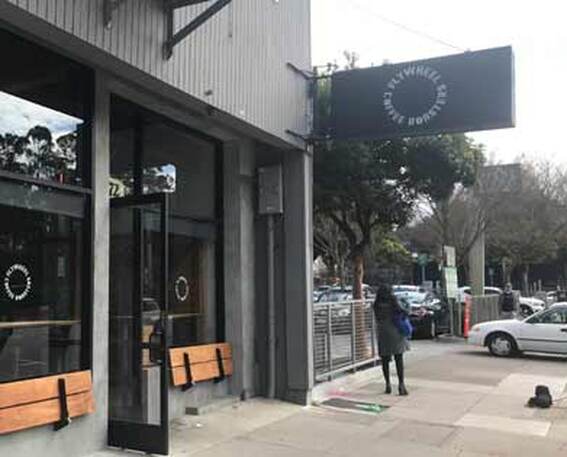
Flywheel Coffee Roasters near San Francisco's Panhandle; Photo by Gary Moran

The Panhandle:  An Embryonic Journey 
by Charlene Anderson


A friend recently asked me whether I would like to be transported back to Haight Street, 1968. She’d caught me off guard and I hemmed and hawed, not wanting to give myself away, as if, after all these years of knowing me, she didn’t already know. Finally, I said, stalling, “So, you’re asking, if I could, would I go back?” I paused, trying to think of something convincing to say. “Well, let’s see. It’s possible . . . I never left. Yes, that’s it. Maybe I’m still there.” I laughed. “Anyway, it’s all stored in here.” I tapped my head. My friend looked perplexed.
 
A few days later, I went with another friend to a coffeehouse in the Haight. We sat in a patio in back in a kind of inside-outside area ‘fenced’ in by boarding and shrubbery. On one side were two young women with two small dogs, all four of them sitting on a bench, getting acquainted. There was a young couple discussing their plans for the day and two men also talking amicably. I was eating a pretty good—for organic—chocolate donut while my friend had tea. I don’t recall what we talked about, but like the space, it was calm and easygoing. So, all the dogs and denizens of the place were ever-so-remarkedly serene.
 
It’s hard to admit—which is why I stuttered so much when my friend asked about it—but for over 50 years, every time I go to Haight Street it is, in some weird way, like returning to, or attempting to return to, 1968. You’d think by now I’d have accepted that that can’t happen. But for one thing, I’m stubborn. For another, I figured out long since that, just by being there, I had a fix on the three spatial dimensions of the space-time continuum, so all I needed was the fourth--time. So, every time I went there, I thought of that and looked, hopefully-foolishly, around, attempting, foolishly-hopefully to recapture time, that is that specific time. I didn’t want the identical situation back, the trappings everybody knows about and scorns, but rather the essence behind that, the humor, the spiking awareness and especially the mind-moving/searing power.
 
As I sat calmly listening to the near-droning/murmuring talk around me, I felt a need, a compulsion almost, to shake up the people in that coffeehouse who, through no fault or virtue of their own, were inhabiting all but one dimension of the world I’d, we’d, left so precipitously behind. I looked around and smiled, not altogether pleasantly. For I knew if I were to act, in my frenzy to awaken them, I’d give no quarter. I would smile disarmingly, twist the blade in mercilessly, and force them all to finally see.
 
That was what I imagined doing. What I actually did was continue chatting ever so calm and pleasantly.

1


A few days later an image of me standing in the Panhandle of Golden Gate Park in front of a depression in the ground popped into my mind. In that mini-vision, I seemed to be preparing to descend into that depression. There may or may not have been steps leading down.
 
At that time, I was in the middle of writing a story, so I was surprised to get an image right then. Usually, my story ‘ideas’ do start with an image, but I’ve never gotten two at the same time before. I finally finished writing that story and the Panhandle image was still there in the back of my mind, apparently waiting patiently for me to pay attention to it. Only, by then, it had morphed some. I was still in the Panhandle, but now I was poised to start down some steps into the ground.
 
Another friend had just returned from Egypt. So, seeing that image made me wonder if I was conjuring up something related to that trip to ancient tombs and to worry that the image might not be related to a story idea at all but rather was some vague, dark reference to my own, possibly imminent, demise. I tried to work with the image anyway, but got nowhere. Yet it wouldn’t politely fade away either, as images that don’t work out always do.
 
So, one nice day in an otherwise rainy December, I headed to the Panhandle—nothing like good old-fashioned, on-the-ground investigation! The image was pretty place-specific within the Panhandle, so I headed where it ‘said’ to go and, lo and behold, there was something there. Three benches were arranged in a semi-circle on a cemented area with an oval section of sand in the center. There was a plaque too, installed as a tribute to a Susan Berman who’d won a battle to keep the Panhandle from being turned into a freeway. I knew nothing about that controversy and had never seen the plaque before. Somehow, it seemed appropriate though, since the site did technically have a dirt area (no stairs!) that someone—certainly not me—could dig up and slip down into.
 
I thought about the Panhandle and the freeway it didn’t become and saw that in a way, for me, it had always been and still was a freeway. The Panhandle, my ‘freeway,’ was physically located between the Haight of my memory and dreams to the south and the more mundane everyday part of my life after Haight Street to the north. So, it ran between the two major segments of my life and was still there, thanks to Susan Berman, and even had a plaque to prove it!
 
I sat taking in the scenery which was impressive since the area was so verdant after all the rains. I tried to vibe the place but there seemed nothing of interest to see or feel. So, convinced that some commiseration was in order, I walked to Haight Street and got a super huge pastry at a donut shop that I know oh-so-very-well.
 
When I was a child, we called those super-pastries ‘long johns’—long, donut-like pastries with maple frosting and gooey custard filling. And pastries, along with brownies and cake and ice cream and cookies and almost every other sweet you can name, have sustained me all my life. Without them—enjoying one now and looking forward to the next one soon—I’d have expired long ago. ​

2


Also as a kid in Wisconsin, when my dad and I sat in our kitchen listening to Milwaukee Braves baseball games on the radio, he drank beer and I ate butterscotch ice cream. So ice cream sustained me then, and baseball did too. Baseball sustained me in those great years of Warren Spahn, Eddie Matthews and Hank Aaron. As it did in 2010, ‘12 and ‘14 when the Giants won the World Series. When they won that first time in 2010, while everybody else was glubbing beer to celebrate, what did I do? I beelined it to the Toy Boat for a caramel ice cream sundae.
 
There are a lot of things that sustain me. And I was determined after that excursion to the Panhandle, to figure out if that image, along with its elusive meaning, was sustaining and nourishing me in some way, or just an aberration I should set aside.
 
 
So I worked with that image some more. I envisioned myself there in the Panhandle standing on the steps looking down into the musty area and, squinting, asked myself: Are the steps steep? Are they new, old, moldering? Is the ’tomb’ area, or whatever it is, dark, light, large, small? I really worked at it, but all I got was—old steps and a dark chamber below.
 
Finally, with much trepidation, I got myself down into that dark place (Only in my mind, you understand!) and tried to look around. It was dark. There seemed to be nothing but a vague idea of walls, stone maybe, but nothing on them and no structures, no hieroglyphics and, thankfully, no mummies or sarcophagi awaiting someone to fill them. (Me?)
 
From time to time, I checked back in, trying to prod that image to expand or move along. Then suddenly one day, I ‘looked’ again and there I was down in the pit itself with—Isn’t it about time?—a light. I swung that light around and round, but all I got was dark and empty walls, still no writing or sarcophagi, not even a mysterious tunnel leading to an even more mysterious and, possibly revelatory, destination.
 
That light itself was pleasant though. At first, it seemed to emanate from that large flashlight I held and shone around. But then I began to see the place as having a glow of its own, separate from my flashlight, as if I had brought a light in and also found light there. The light, no matter what its source, was amber-colored and filled the chamber with subdued yet somehow also stimulating light.
 
As I continued to view that image in my head, that suffusing yellow light got into me. It swirled around inside my brain. Yet, even as I felt its presence and its force, I pondered why there was nothing in that place except that pale, enduring light. 

3


Then on New Year’s Eve morning, I woke up, and everything had changed and everything was there. I saw myself now standing above ground, lifting my arms into the air. The sun was shining brightly. There was no longer a depression in the ground. And emanating upward from my up-reaching hands was that long-held, and, as I saw now, transformative and unquestionably sustaining light.
 
I realized then that that below-ground ‘room’ hadn’t been a tomb at all, but a storage area, a capacitator, for the light we’d discovered and/or kindled all those years ago. That light had been stored there, sheltered underground, on that ‘freeway’ between the two worlds of 1968 and all succeeding time. It was held there like a memory—much as the memories of that time were stored in my head. But it wasn’t a memory, rather a thing of energy and power, to be released at the right time, in just the right way.
 
Somebody had to do it. And apparently, that somebody was me.
 
So that light, that encapsulated power to change, is gone now. After all these years, it’s been unleashed, set free. Standing in the Panhandle, in and outside of my mind, I feel that light moving. I feel it turning above me in the trees and in the sky, winding with, twisting through and around, the world.
 
I’m off to get some ice cream now, and maybe a long john too. It’s a new year, a new world, and time to celebrate a hard-fought but, hopefully, at long-last, winning season.
 
As I walk up the hill, back to the Street, I’ll be watching for a trace of yellow light. I’ll be listening for just the right song or the right voice, or a hint of laughter that I recognize. And most of all, I’ll be looking for the right set of eyes that smile and blink and open up, and see.
 
We used to say that there was no waiting, should be no waiting, that the world should change right now.
 
Right now has come. Right now is finally here.

4

ABOUT THE AUTHOR
Charlene Anderson received an MA in English Literature from Purdue University and an MA in Research Psychology from San Francisco State University and spent most of her working life at the University of California San Francisco in grant administration. As a child, she always knew she would write, told stories to her friends, and even invented a pen name for herself, Charles Andrè. So, while working on budgets and submitting grant proposals at UCSF, she continued to write and, in 2001 published a novel, Berkeley’s Best Buddhist Bookstore. When Vistas & Byways was launched in 2015, she was pleased to be asked to chair the Editorial Board. She has served in that capacity ever since.
Other works in this issue:
Fiction
Glued to the Ground
Bay Area Byways
Off to Lunch in the Neighborhood

Vertical Divider
    WE WELCOME COMMENTS
Submit Comment

​Return to the Table of Contents
Picture
​Vistas & Byways Review is the semiannual journal of fiction, nonfiction and poetry by members of Osher Lifelong Learning Institute (OLLI) at San Francisco State University​.
Vertical Divider
Picture
Osher Lifelong Learning Institute at San Francisco State University​ (OLLI at SF State) provides communal and material support to the Vistas & Byways  volunteer staff.

Contact THE V&B
Powered by Create your own unique website with customizable templates.
  • Contents
    • In This Issue
    • Fiction
    • Nonfiction
    • Poetry
    • Bay Area Byways
    • Bay Area Stew
    • Inside OLLI
  • About Us
  • Contributors
  • Submissions
  • LATEST V&B ISSUE